



The universe is infinitely vast, and what we know about it is merely the tip of the iceberg. Yet researchers are managing to uncover more and more. Through her final-year project, ICT student Saamie Vincken is making an important contribution to research carried out by the European Space Agency (ESA).
The title of her final-year project is: ‘Automatic segmentation of strong gravitational lenses in data from the Euclid space telescope’. Quite a mouthful, the student admits, and not easy for the layperson to understand either. So, on Wednesday, during her graduation presentation at the Fontys ICT Graduation Conference (see box below), Saamie took the time to explain what she is working on. Because it is certainly clear that it is important.
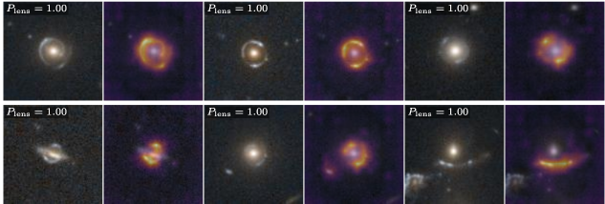
“ESA’s Euclid space telescope captures images of vast swathes of space: around a third of the entire observable universe. Hidden within those images are rare objects known as strong gravitational lenses. In this phenomenon, a massive galaxy in the foreground bends the light from a more distant galaxy behind it, just as a lens in a pair of spectacles does. As a result, that distant galaxy appears stretched into arcs or rings,” explains Saamie.
As part of her project, the ICT student has built AI tools that do two things: first, they identify these lenses amongst millions of objects; and second, for each system, they break down the image into different components: the foreground galaxy, the bent light from the background galaxy, and other objects that happen to be nearby.
Dark matter
According to Saamie, gravitational lenses are important for research into dark matter. “Most of a galaxy’s mass consists of dark matter, which is invisible. Through gravitational lenses, we can still see how that mass is distributed.” The lenses also help researchers learn more about dark energy and the expansion of the universe.
During its five-year mission, Euclid will capture images of around 1.5 billion galaxies. Only 0.01 per cent of these are expected to contain a strong gravitational lens. “It’s impossible to search through that volume manually,” says Saamie. “That’s why I use AI networks. So far, more than 70 million galaxies have already been searched.”
Saamie’s AI model uses transformers, similar to the technology behind large language models. This technique proved particularly effective at recognising larger and more complex lensing systems, such as those on a group or cluster scale.
A visualisation of how transformers process information and make connections
But not everything is fully automated. “One of the functions of the AI model is that it assigns each image a score indicating how likely it is to contain a lens. The systems are then ranked from highest to lowest. The highest-scoring images are subsequently checked visually by volunteer citizen scientists and experts.”
What makes her AI model so special is that it goes a step further than most existing lens detectors. Whereas other models merely indicate whether something is a lens, Saamie’s model breaks the image down pixel by pixel. As a result, researchers no longer need to manually determine which light belongs to which object. “By automating that process, analysis on the scale of Euclid becomes feasible.”
Gyro Gearloose moment
Her Gyro Gearloose moment came when Saamie compared the figures. “Until now, the largest collections of strong gravitational lenses consisted of a few hundred objects, gathered over decades. With this method, we’re working towards more than 10,000 lenses from a single data release. That’s when I really realised just how big this could become.”
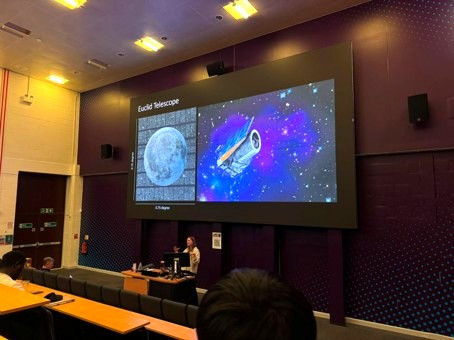
Saamie during the presentation of her final-year project
And this is just the beginning of Euclid’s five-year mission. According to Saamie, it is precisely this scale that makes it so valuable: whereas researchers previously studied lenses one by one, they will soon be able to analyse tens of thousands of systems in the same way. This will make it possible to investigate much more effectively how mass and dark matter are distributed across galaxies.
Outstanding
The final-year project has had a major impact on Saamie’s career. Her first methodological paper on the strong-lensing survey network was published during Euclid’s first public data release (DR1). She is now leading two further papers, which will be published in November in the journal *Astronomy & Astrophysics*, just like the first publication.
It is exceptional for a final-year student to lead publications within such an international research collaboration. It was therefore not a question of whether Saamie would succeed, but how. Her first and second assessors, her internship supervisor and an external expert all rated her work as excellent. In September, she will begin the Master of Applied IT programme at Fontys in Eindhoven.
Fontys ICT Graduation Conference
From 29 June to 8 July, the Fontys ICT Graduation Conference will take place in R10 on the Rachelsmolen campus, forming part of the students’ graduation celebrations. They will present and demonstrate their work, enabling the jury and other interested parties to gain a better understanding of the assignment and the work the students have carried out.

Fontys Hogeschool ICT
Rachelsmolen 1, gebouw R10
5612 MA Eindhoven
fontysict-alumni@fontys.nl
Copyright © 2026 Fontys School of Information and Communication Technology