



What do engineering and music students have in common? Surprisingly a lot! The link between these two completely different disciplines turns out to be enormous, which is why they are increasingly seeking each other out. This is also the case with the ‘Be Creative’ minor, where engineering students were set the task of designing a musical instrument that does not yet exist.
The project forms part of Project Beethoven, which aims to increase the intake into the microchip industry in the Netherlands. At Fontys Technology, they have observed for years that engineering students often engage with music at an above-average level, and so they have been exploring ways to better underpin the connection between music and engineering. The ultimate aim, therefore, is to increase that intake.
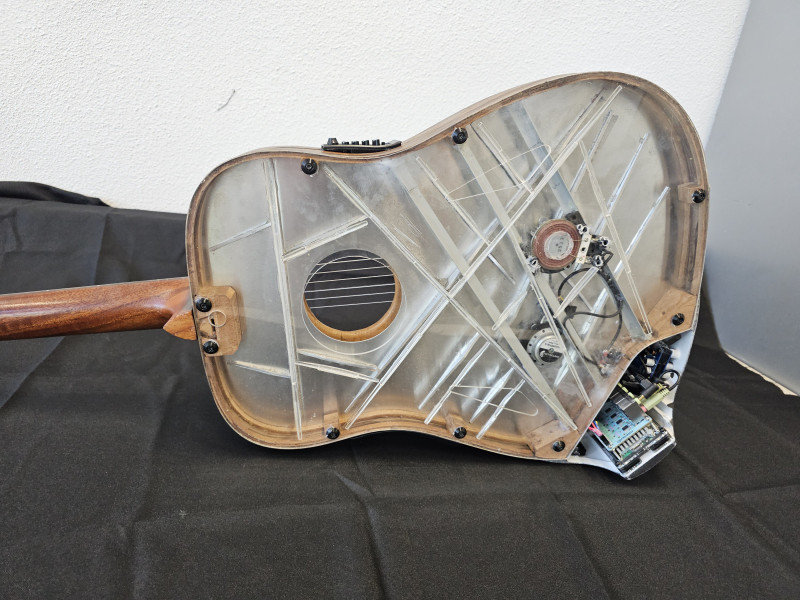
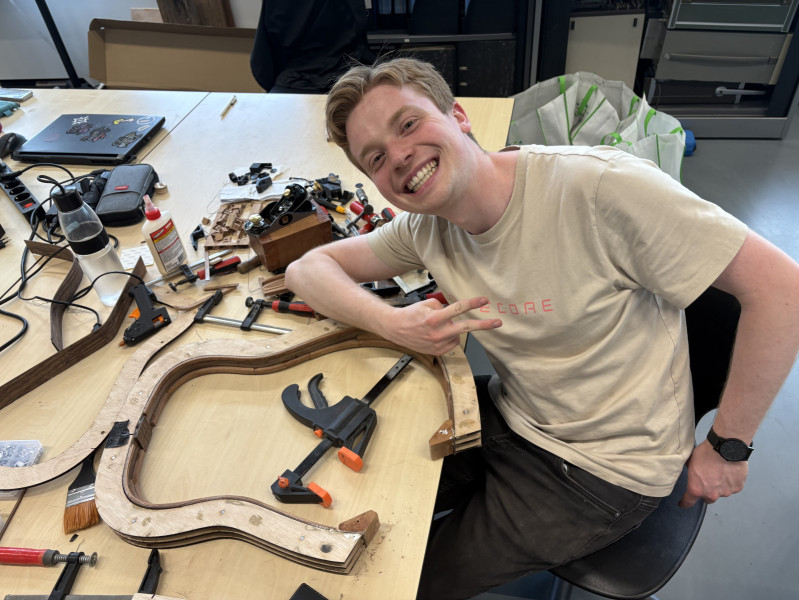
As part of ‘Be Creative’, a technical project-based minor for engineering students, a brand-new assignment was devised on behalf of the conservatoire: to create a musical instrument that does not yet exist. Four students set to work on this and presented the end result this summer: a guitar offering a wide range of possibilities in terms of sound, range and a playing style that is impossible on conventional guitars.
A different sound
Fontys students Daan van Alebeek and Micha van Zutphen are two of the four minds behind the instrument. “We started with a concept that doesn’t exist anywhere else in the world, but which is most comparable to Yamaha’s TransAcoustic guitar,” explains Micha. “That allows you to create all sorts of effects on an acoustic guitar. We looked at how we could make that even more interesting and unique by, for example, integrating different plates into the body of the guitar.”
For those in the know: these are plates made of plexiglass and aluminium. For those who aren’t, Daan provides a bit more information. “We retain the acoustic sound of the guitar, but by adding laser-cut strings and mixing different materials – and transmitting these via electronics – you get a different kind of sound. What’s more: you can decide for yourself what percentage of the wood effect you want to hear, how much of the aluminium and how much of the plexiglass. By experimenting with this, you get completely different tones using exactly the same strings.”
Interaction with the audience
Once the guitar is fully finished, the instrument will be handed over to students at the conservatoire. They will learn to play it and will compose their own piece of music specifically for this instrument, which will be performed in the autumn during the November Music Festival. Aart Strootman, a lecturer and researcher at Fontys Academy of the Arts, is very curious to see how this will turn out. “I can well imagine that when we start using this instrument on stage, it will spark a conversation. Interaction with the audience – that’s what we’re hoping for. Much more than the instrument conquering the international market.”
Strootman is conducting research into the links between music and technology. He sees many connections and notes that there is considerable potential for overlap between these two fields, but he also realises that establishing those links is no easy task.
Connecting disciplines
“You don’t study IT to become a guitarist. The reverse is equally true. Moreover, not everyone has an affinity for the other discipline, which makes it difficult to incorporate technology into the music curriculum, and vice versa. The only option left, then, is to organise exchanges through projects or minor programmes that students choose for themselves.”
‘Be Creative’ is an example of this. This minor offers various projects, one of which is ‘Music and Technology’. “I’m delighted that the first round was a success and I hope we can continue in the same vein,” Strootman continues. “Because at the moment we have one tool, but the more tools we can create in this way, the larger the group of musicians and engineers we can inspire to pursue a career in engineering.”

Fontys Hogeschool ICT
Rachelsmolen 1, gebouw R10
5612 MA Eindhoven
fontysict-alumni@fontys.nl
Copyright © 2026 Fontys School of Information and Communication Technology