



Many organisations get stuck at the pilot stage when it comes to AI, but Virtual Computing in Oisterwijk shows how it can be done: deploying AI as a fully-fledged part of business operations. In this episode of the AI Garage podcast, co-owner Mohammad Moghtader and colleague Luc Tortike explain how they built a digital colleague called Alex. Alex takes over routine tasks, speeds up processes and helps customers within seconds. Their story makes it clear that AI is not just hype, but a strategic choice.
Virtual Computing provides online workspaces for SMEs and saw a sharp rise in demand for efficiency. That’s why they developed Alex (fun fact: the name was actually thought up by the AI employee himself), a digital colleague who handles tickets, resets passwords, creates accounts, restarts servers, does the admin and much more. Not a chatbot, but an integrated team member within the service desk. As Mohammad says: “You shouldn’t want to use AI just because of FOMO. You really need to approach it with a strategy and a clear vision.”
Alex works on dozens of requests simultaneously, allowing staff to focus on more complex issues. Things went wrong a lot at the start, says Luc, but after months of training, Alex is fast, reliable and secure. Critical actions are protected by robust code, deliberately limiting its autonomy. Think of it as a real employee – he or she will also need training once they start work.
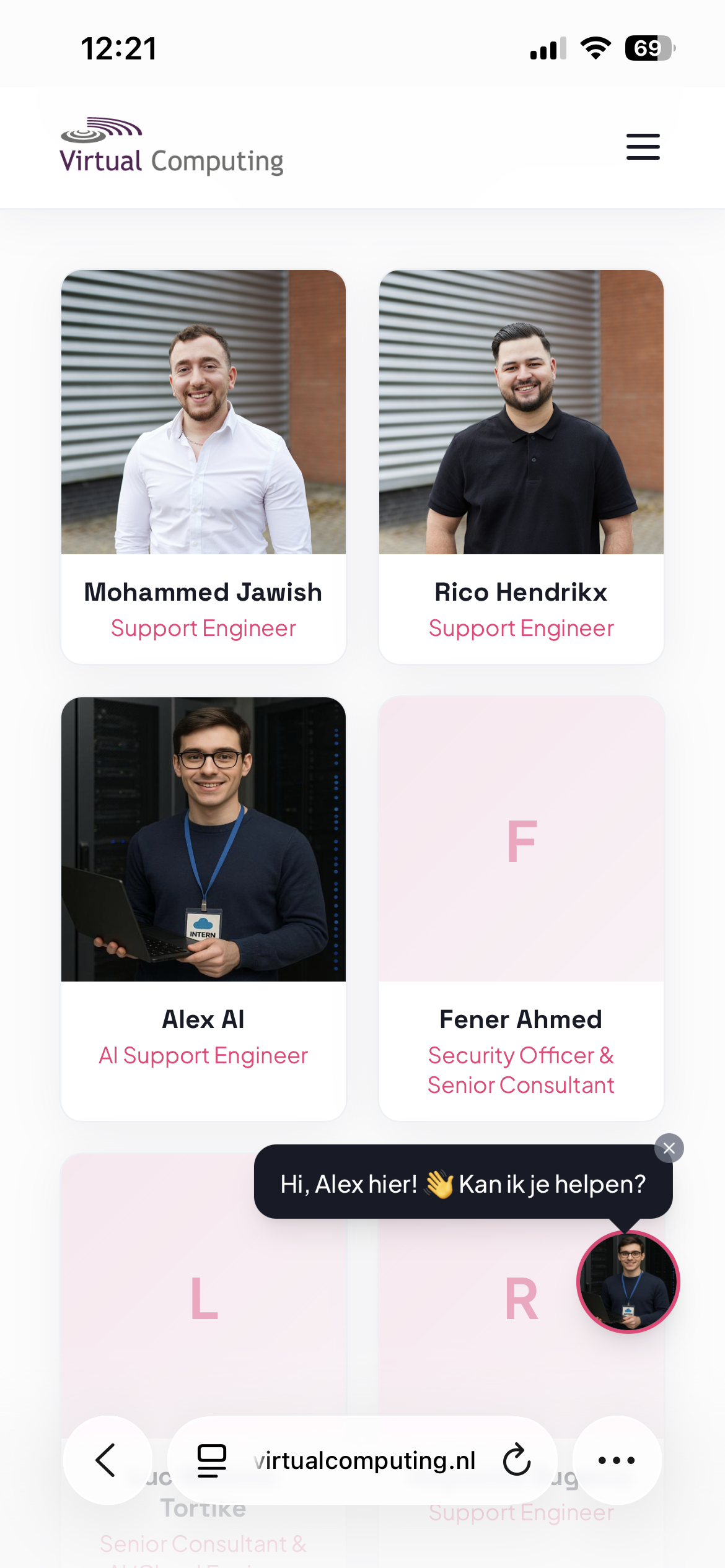
The impact is significant: customers receive an answer almost immediately, and internally there is a growing realisation that AI does not replace jobs, but makes work smarter. Virtual Computing is now also building “Alex variants” for its customers. What began as an idea and an experiment has grown into a fully-fledged team member; with its own space on the website as an employee and an increasingly important role within the company.
Listen to the podcast (in Dutch) via Spotify or Apple Podcasts.


Fontys Hogeschool ICT
Rachelsmolen 1, gebouw R10
5612 MA Eindhoven
fontysict-alumni@fontys.nl
Copyright © 2026 Fontys School of Information and Communication Technology